


In 2012 a nineteen-year-old in Bromsgrove was screen-printing gym vests in his parents’ garage while driving Pizza Hut deliveries to pay for fabrics. Ben Francis could not afford marketing his gym vests and so he did what you would expect from a teenager with no money and a YouTube account. He sent free kit to fitness creators, the ones filming their workouts for niche audiences and asked them to wear it. Gymshark was carried into the category on the shoulders of people its customers already trusted. The brand is now valued north of a billion pounds and sells in more than 180 countries.
That was the ceiling a decade ago when only the upstarts thought this way. The incumbents have caught on. Coach, L’Oréal and Unilever for instance are brands with the budget to run nationwide TV campaigns but chose to grow through YouTube creators instead, and their own independent numbers say that it worked against their own business outcomes. Most established brands are still nowhere near it. They treat YouTube as a cost efficient place to run the thirty-second film they already made for TV, run it as skippable pre-roll, and count completed views. That is the commodity path that competes away the moment the rest of the category runs the same play.
Run your TV ad as pre-roll AND build with the creator into the living room, and you have a differentiated route into the category.
In a nutshell
YouTube is the most-watched video-sharing platform on the British TV sets, and the TV set is now the main way British households watch it.
Commercial broadcaster revenue fell last year while the total commercial TV and online video market grew. The money is certainly migrating.
Most brands still use YouTube as a cost efficient - measured against view rates -pre-roll for a TV ad they already made. That is the commodity path and it competes away in the category if run in isolation.
Creators are a unique non-commodified route into a category rather than a line on the media plan. Gymshark, Feastables and Prime all entered through them.
Incumbents are shining a light for the rest. Coach, L’Oréal and Unilever grew brand metrics through YouTube creators, measured by their own independent models.
The inventive brands engineer one creator asset to work across the phone, the living-room screen and the checkout.
It’s an AND not an OR. Run video ads + creator partnerships.
YouTube took the TV set while broadcaster revenue fell
Ofcom counted how Brits watched for two decades, and its 2026 Media Nations reported average daily YouTube viewing on the TV doubled from nine minutes per person in 2022 to nineteen in 2025. Across every connected device in the home the figure reached forty-one minutes a day. The share of video-sharing platform viewing that happens through TV climbed from 32 percent to 37 percent, and YouTube drove it. Among 16 to 34 year-olds, YouTube now takes the largest share of in-home video viewing of anything, broadcasters included. The living room used to be the one room the internet could not reach.
The money has followed.
The UK commercial TV and online video market grew to £18.4 billion in 2025, up from £17.1 billion. Over the same year commercial broadcaster revenue fell from £4.98 billion to £4.83 billion. So the market got bigger and the broadcasters got smaller.
And broadcasters know it. In June 2026 ITV, Channel 4 and Sky launched Universal Ads, a self-service platform built to make buying TV feel like buying social and Global launched AdPower for audio and outdoor in the same month.
The buy-side battleground has already turned.
The share of UK media agencies planning to run YouTube on the TV screen went from 23 percent to 85 percent in a single year, and more than half say they are targeting high-value creators rather than pro-broadcast content. That number comes from Pixability’s annual agency survey, and Pixability sells into this market, so read it what you will.
Gymshark and Feastables entered their categories through creators, and Prime shows the limit
Gymshark’s garage story is not a fluke. It is a repeatable mechanic, and the brands that understand it treat a creator as a differentiated way into a category rather than a bolt-on to a campaign.
Feastables is the clearest current example. MrBeast, the most-subscribed individual on the platform with north of 450 million subscribers built his own chocolate brand and used the audience as the distribution. Then Feastables put its logo on the Charlotte Hornets’ jerseys, the first time a creator’s brand had taken a patch on a major American sports team, and MrBeast has since hired a former YouTube and Meta executive to run brand partnerships and signed a multi-video sponsorship with the jerky brand Jack Link’s. The chocolate is real. It sits in real supermarkets and it reached the shelf on the back of smart creator work.
A heed of warning.
Prime - the drink from KSI and Logan Paul - entered the sports-drink category at rapid pace. In its first year it did around a quarter of a billion dollars in retail sales. Cans resold for absurd amounts and it outsold Gatorade at Walmart and held more than 40 percent of the sports-drink segment at its peak. Then the scarcity declined and the product turned out to be perceived as ordinary and UK turnover fell from £112.2 million to £32.8 million in a single year, with segment share down from 41.2 percent to 10.4. So Creators handed Prime category advantage at rapid pace and its decline is down to a disproportionate focus on creators getting a brand into a category and not enough focus on staying there.
Coach, L'Oréal and Unilever now run the same play with purpose
Heritage brands now win younger categories through creators.
Coach is the best in class case. Its ‘Explore Your Story’ campaign put creators at the heart and reported a 60 percent jump in brand awareness among Gen Z, a sixfold rise in consideration, and sustained acceleration in Gen Z acquisition. A leather-goods brand founded in 1941 leveraged creators to find its way back into a generation.
L’Oréal made it an operating model rather than a campaign. It produced more than a thousand creator-led videos in a single year, and its ‘Infallible foundation’ campaign reported six times incremental return on ad spend, with 61 percent of that contribution coming from new category buyers - creators were bringing net new people.
Unilever ran it at portfolio scale, using creators, fandoms and cultural moments to grow its YouTube return more than 50 percent year on year across several of its brands. Additionally, Duolingo and Ulta build creator-first rather than ad-first.
Read those numbers with one eye open, as most come from YouTube’s own upfronts and playbooks. The neutral read comes from Kantar whose study found creator partnerships lifted aided brand awareness by 9 percent, running 1.6 times ahead of standard brand ads.
One thing is for sure. Global brands treating creators as a build program are pulling away from the ones treating YouTube as cost efficient reach.
One creator video now has to work on the phone, the TV and at the checkout
A single creator video now travels across three different layers of attention. Someone finds it on a phone on the morning commute. They push it to the living-room screen that evening and watch it leaned back. They buy from a shopping prompt or a QR code the next morning. The commodity buyer makes three assets for three channels. The inventive buyer engineers one creator asset to carry across all three layers and lets YouTube seemlessly move it between the layers.
Creators can leave swappable slots inside their videos that a brand segment drops into, so one piece of content carries different sponsors by audience. Shoppable formats let a viewer browse and buy from the big screen. A brand can sponsor a creator’s series end-to-end, a takeover built for the living room rather than a bolted on pre-roll.
And the hardest part is finding the creator before they get too famous and too expensive. Pixability feed audience-velocity signals into targeting so a brand can back and ride a creator on the way up. One wellness brand used it to partner with a Maine lobsterman who films his catch for two and a half million people before the rest of the market had noticed him.
YouTube, the creator, the connected screen and the checkout is the most powerful lever not pulled by brands.
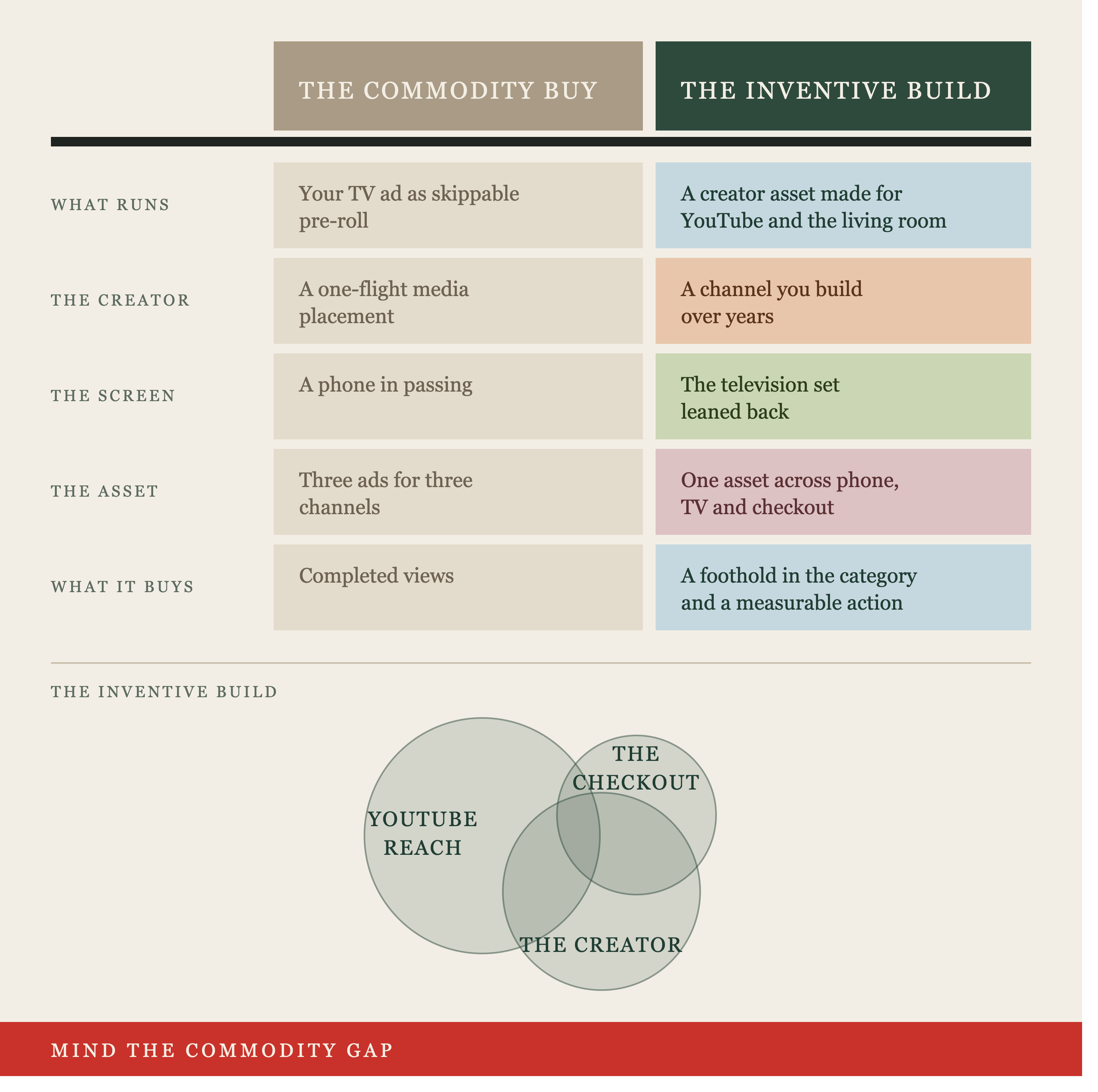
A launch stops being a media plan-powered reach announcement and becomes a creator putting the product in front of an audience that trusts them on the screen in the living room with a shopping prompt attached.
Retail media stops being a banner on a grocer’s website and becomes a creator demonstrating the thing watchable on the big screen and measurable to the checkout.
Brand-building stops being a wholly reach and frequency play and becomes a series people choose to watch rather than choose to skip.
Ben Francis took a chunk from the category creating inventive ways in through creators. The living room he reached is now the biggest screen on the platform and for anyone under thirty-five the platform is now the biggest thing on that screen. The brands still treating it as a cost efficient reach buy slot for TV ads are doing the exact thing Mind the Commodity gaps warns about.. They are pressing the default button while brands are winning by building. Building a mini ecosytem powered by creators of which a reach buy is a small but still important part.
This is Erfan Djazmi, sharing notes on the commodity gap in marketing, from someone who has spent the past five years decommoditising agency and client investment.