


In 1928, Simon Marks registered a brand called St Michael, and Marks & Spencer began an experiment to create a shop that would eventually sell nothing it did not make to its own spec. The broader trade thought it was eccentric. The model was that manufacturers would make things and shopkeepers would sell them. The margin structure reflected that division of work. A century later, own-label goods take more than half of UK grocery spend, Aldi built the UK’s fastest-growing supermarket on a product range that is almost all own-label, and the manufacturers who once owned the shelf now rent the shelf and compete in a fierce battleground for shelf space.
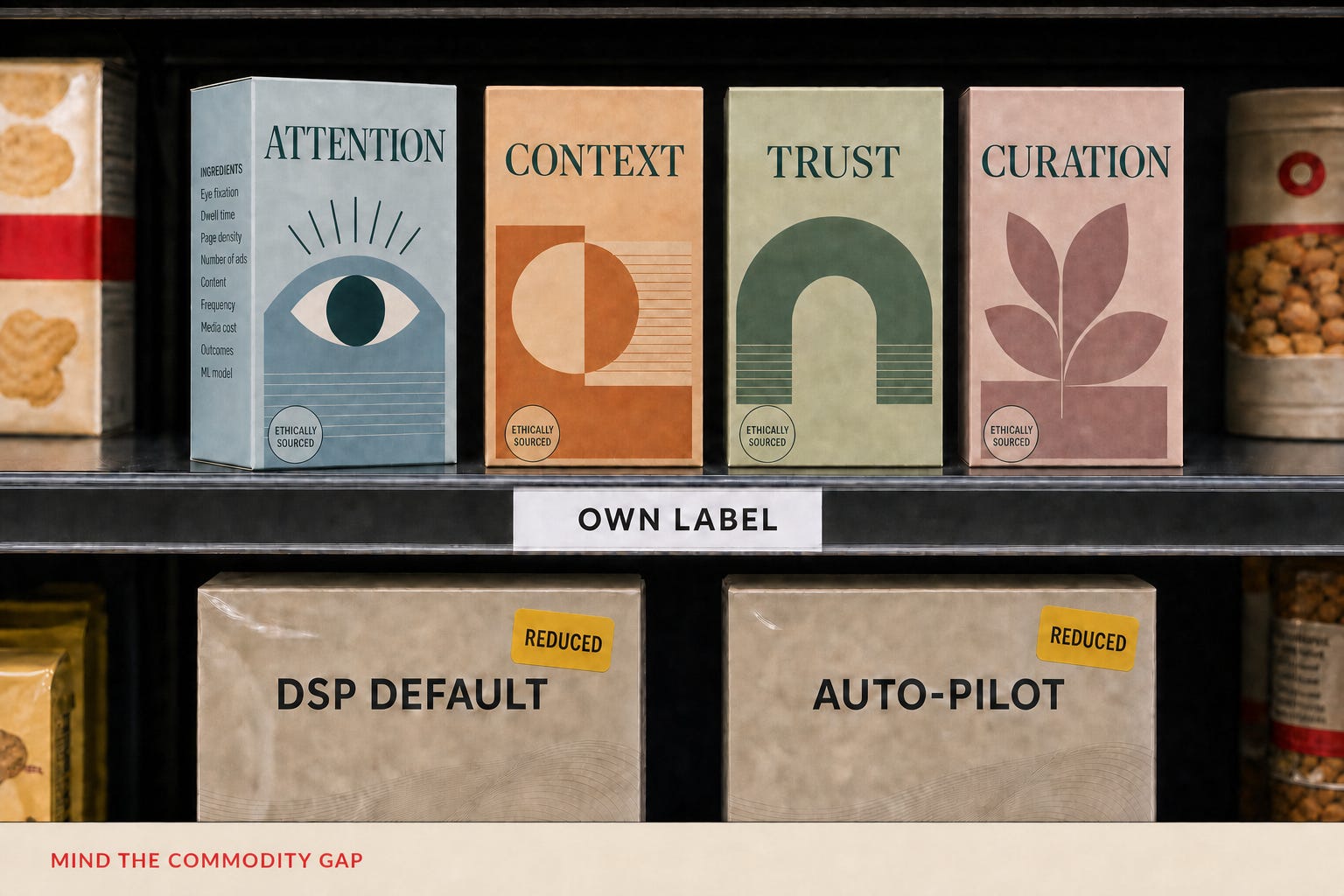
Media agencies spent twenty-five years as distributors. They rented other people’s technology, DSP seats, verification licences, the platforms’ own buttons, marked it up where they could, and sold it as a service. Every layer of the stack belonged to someone else, which meant every layer’s margin belong to everyone else too. The interesting agencies have now started doing what Marks did - taking the supplier’s ingredients and building IP and products to their own spec, that solve very real client problems, and proving the impact brand and sales outcomes. They broker data under the deal, ingest it, that allows them to build their own inventory cluster models, and wire those models into custom bidding optimisers and curated inventory marketplaces that become agency IP that the agency can ligitimately charge as data and tech fees. So, own-label adtech, with the same commercial outcomes the grocers discovered where they have control of the recipe, and a margin that no longer belongs to the landlord.
Rent the tech and you rent the margin with it. Build the model and the fee finally stays in the building.
In a nutshell
Media agencies spent twenty-five years operating as distributors, renting DSP seats and platform tools.
The interesting agencies are now building their own contextual models on licensed vendor data, own-label adtech with the same economics grocers discovered decades ago.
Contextual vendors like Peer39 and GumGum plug into the bid stream and let an agency define what ‘relevant’ and ‘premium’ mean at a client and campaign level, which the off-the-shelf bidding tools never allow.
It is not only contextual. Attention data from Lumen, reliability data from NewsGuard, and creative scores from Human Made Machine feed the same model, so the agency prices quality on more than contextual page signals.
The commercial model that survives scrutiny is a disclosed tech fee benchmarked against default platform as a holdout, not an undisclosed take hidden inside the supply chain.
At a time when agencies are seeking revenue to rebalance a P&L built on headcount. A recurring, margin-rich fee boosts organic revenue and margin.
Own-label only worked in retail because the goods stayed good. Incremental performance uplifts measured in MMM and brand surveys keep the agency’s model honest too.
In a world where agencies take positions on media and earn a margin, that model is becoming harder to sustain given more investment is moving into walled gardens, where those opportunities are finite.
This article sets out a defensive position against two growing pressure points. The risk of client fees falling as automation reduces the need for FTE support, while trading revenue is also shrinking as more media spend moves into walled gardens.
Contextual: the battleground sparked by privacy rules
The battleground is contextual for two main structural reasons. Privacy regulation and signal loss have raised the bid price of audience data while contextual data is essentially personal ads without personal data. And the data itself has become rich and dense. Contextual once meant a keyword and a category flag. It now means domain-level and page-level scoring with predictions. The emotional triggers a piece of content is likely to fire, the interest and intent signals in its semantic language, the programme-level context of a CTV slot rather than a broad genre label.
Peer39 and GumGum are neat examples. Both plug straight into the bid stream. Peer39 classifies each page in real time. It reads the page itself rather than spinning up to the domain, carries more than 2,000 pre-bid contextual categories, and evaluates hundreds of billions of URLs and videos a day, passing the result onto the DSP before the bid even fires. GumGum’s Verity engine goes wider. Its computer vision and language models read the images, audio and video on a page, not just the words, and return a contextual and brand-safety score in under ten milliseconds.
The off-the-shelf bidding tools cannot act on any of this. A DSP seat out of the box gives you a viewability floor and a blocklist, the same two levers every brand in the category pulls. It will not let you customise bids because articles related to the Women’s Super League are more valuable for the brand than articles about the Premier League. It will not let you pull that inventory into a private deal or proprietary agency marketplace.
Controlling bids and inventory at the level of context is not a setting that gets switched on. It is a capability you build, by licensing the vendor feed and integrating it into custom bidding logic and curated deal IDs the agency owns. This creates the ability for agencies to define what ‘relevant’ and ‘premium’ could mean at a client and campaign level.
And it is not only contextual.
The same inventory pipe of media quality signals carries more than page meaning.
Attention data from Lumen (who were first to market for this model) measures whether real people actually look at an ad rather than whether it technically rendered, so the model can price attentive inventory instead of served impressions.
Responsible data from TheGoodNet - who rate news sites for trustworthiness, lets the marketplace fund real journalism at scale and keep clients off misinformation, without the blunt keyword blocklist that either blocks too much or not enough - that cant get to a sweet spot of misinformation.
Creative scores from Human Made Machine, whose control-versus-exposed brand-lift experiments create structured creative signals that better inform media allocation decisions.
Other partners with mature open-source data brokerage models include Peer39 (CTV + web context), RAAS LAB (context), Teads (curation) and Adelaide (attention).
How it works.
Integrate all of that with the agency’s own bid-stream pricing history and you can build curated deal IDs. Your own marketplaces, where inventory qualifies by the agency’s definition of quality and provides brands with value beyond the commoditised category all pressing the same off-the-shelf buttons. The holdcos are building the ingredients. Publicis is rumored to aquire Lotame to thicken its data spine. GroupM has built curated marketplaces with carbon and quality partners. Every group now has a version of this living in pitch decks and real IP.
That is the whole distinction. Slides create the idea. The product is the built model, the IP and the supply path that drive client value and outcomes. The only thing that turns one into the other is actually building the thing.
The build, and the fee: what agencies actually create
The workflow moves something like this. Agencies broker data from adtech either at an annual level of campaign level. Data feeds land in the agency’s instance. Data engineers join them at domain, page and programme level with clearing prices and outcome data. Models score and cluster the inventory. The clusters become custom bidding logic in the DSPs and deal IDs in the SSPs. Performance flows back and retrains the model. Multi-agentic agentskeeps this running daily without hoards of engineers. The output is a supply path the agency controls end to end, customised for each client that self learns and improves over time.
How the fee works.
This work justifies a technology and IP fee that is disclosed on a per-thousand CPM, % of media or a flat fee, in exchange for a capability the client can benchmark and earns category advantage vs. the rest that press defaul commoditised optimisation buttons. That test is what separates own-label adtech from the practice The Trade Desk has spent two years buiding, where curation means an undisclosed slice taken inside the supply chain and the client cannot see the fee or test the value.
What the client gets: augmented trasparent bidding and not a black box
Own-label survived in grocery by being good. The same logic applies to media buying. When a client invests in programmatic through an exchange, they’re basically buying from a big generic pool of inventory with average inventory, average quality. But if an agency builds its own proprietary contextual data with - real insight into what placements actually work - the client isn’t buying generic commoditised inventory anymore. They’re buying inventory that’s been clustered, filtered and scored specifically for their brand’s tactics, not just the market average.
It gets an escape from the sea of sameness of running the identical verification filters and identical platform default bidding settings as every brand in the category. And it gets a measurable outcome, which fifty years of media buying rarely offered. The curated path either beats the open default path in a holdout or it does not, and the fee is justified by that comparison or it does not.
Two caveats though.
An agency that owns the marketplace it recommends carries a conflict issue and the cure is the same. Disclosure and a clients right and ability to validate. And the models decay because publishers optimise toward whatever buyers score. A curation product built once and left running becomes a blocklist with a fee attached. The own-label grocers never stopped reformulating, which is why the range still sells.
St Michael took sixty years to go from a tad eccentric to the default economics of British retail, and the manufacturers never really got the shelf back. The agencies building their own contextual models are running the same game but much faster, and the vendors - like the best own-label suppliers - will profit from open sourcing their data and arming them. The platforms and exchanges, who have effectively owned the shelf for twenty years, might reflect on how that story ended for the folks who made the assumption that distribution was theirs by right. The shopkeepers learned to make things. Clients will pay a fair price for the recipe, and only for the recipe, as long as it looks and tastes good.
This is Erfan Djazmi, sharing notes on the commodity gap in marketing, from someone who has spent the past five years decommoditising agency and client investment.