


In 2005, Staples began selling the Easy Button. An advertising conceit. Bascially you press it and office supplies appear and it became a product. A red plastic thing that said ‘that was easy’ when pressed and millions of people bought one.
Twenty years on, the advertising industry has built a smiliar thing. Meta calls it Advantage+, Google calls it Performance Max and by 2024 Meta was reporting a $20 billion annual run-rate through its version. Essentially, you press ‘the button’, relax the levers, and the machine buys the media.
The button works. Here’s why.
The models train on purchase behaviour and they improve each quarter - morso than any brand ever gets access to. Give it a few weeks of learning and it becomes frighteningly effective. The trouble starts when the whole category presses it at once. The machines learn from the same signals, so they find the same shoppers, the ones already close to buying, and multiple brands’ bidding algorithms end up bidding against each other for the same people and auction prices rise for everyone.
Meanwhile the dashboards keep showing sales taking credit for shoppers who were coming anyway. The category sells no more than before and the same buyers get reallocated at a higher media cost. No single brand can stop pressing, since sitting out hands share to the neighbours, and so the category pays more each year to hold the same positions.
The button has become electricity. You cannot run the shop without it, and it differentiates very little.
In a nutshell
When everyone presses Advantage+ or Performance Max , the efficiency gains get competed away and auction prices rise.
The commodity gap is the margin between default bidding automation and a better-taught machine.
Brands close the gap with better inputs. Agencies close it by augmenting platforms and turning those inputs into data and tech IP and recurring fees.
Platforms and adtech monetise better data, better proof and better infrastructure.
Agentic automation frees agency people from the drudgery so they can build those better inputs, feeding the augmented system.
The distance between that commodity baseline and what a better-taught machine earns is the commodity gap. And it’s zero-sum becuase platforms capture the value, and the rest of the ecosystem plays a kind of supporting act. This piece argues the reverse. The gap is a place where all boats rise - brands, agencies, platforms and adtech vendors can all make money at once, and mostly by helping and feeding each other.
The same button applies in the open web. The Trade Desk sells Kokai as autopilot and DV360 pushes its automated tiers for instance. The money leaks differently there through platform fees and curation take rates rather than one auction the seller also banks (that side is covered in depth in a future issue).
Here are the layers in turn.
Brands: feed the machine what your rivals don’t, and win the same auction
For a brand the commodity gap is a category-level opening, because your competitors’ default bidding settings are the baseline you get measured against. While the category presses ‘the button’ on default settings, you can augment the same machine and earn an advantage inside the auction. First-party data flows back through server-side signals instead of a pixel. Conversion values get rebuilt as margin-weighted lifetime value instead of revenue, so the algo stops treating a discount-hunter and a decade-long customer as the same value. Clean-room curation, the Amazon Marketing Cloud and Ads Data Hub produces audiences and incrementality reads.
Google and Meta have already built a path for brands to augment beyond the commodity gap. Advertisers don’t need to wait for permission or new tech - the tools already exist inside the platforms themselves. What they may lack, however, are the inputs and thats where agencies earn their value.
Agencies: sell the data and the model, not the hours
For agencies, the gap addresses the most talked-about commercial problem in adland. We have complicated the commercial model by pinning to time and there is a way out. Fee income is tied to headcount, easily benchmarked by procurement, and compressed by the same AI that is commoditising the buying. The gap is new revenue models.
Here’s how
Custom cluster models, audience and contextual segmentation and media quality signals built on the client’s own data instead of off-the-shelf taxonomies become agency IP with a tech fee attached. Marketing mix modelling has become the growth discipline of the decade, helped by the platforms themselves with Meta open-sourcing Robyn and Google’s Meridian, which are free toolkits for building a model of which channels drive sales.
Agencies can still build MMM from scratch, but Robyn and Meridian cut the engineering lift, standardise the core methodology, and return outputs faster, so the entry point has never been easier. It still needs an operating layer, and agencies can own it, refreshing MMM reads in real time and wiring them into bidding and budget allocation so the model steers investment, moving from slow, backward-looking data to fast moving forward data feeding bidding logic and custom optimisers.
Clean-room brokerage adds a new intermediary role. The agency structures data collaborations between a brand, a retailer and a platform, and charges for the deal architecture, and a snip on incremental outcomes driven by the clean room, instead of the hours.
For example.
A clean room allows Retailer A to sell more incremental skews for Brand B due to having better-structured data from the clean room data. As a result, Brand B generates incremental revenue through increased sales. Brand B then shares an agreed percentage of that incremental revenue with Retailer A, and the agency receives an agreed percentage of Retailer A’s share as compensation.
The awkward question is who builds all this and agentic automation give us the answer.
The people capable of designing a clean room or an identity spine are the agency’s best, and today they spend excessive time on reports, reconciling numbers and feeding decks, because that is what the retainer pays for.
Agent workflows take away the drudgery, and the freed talent focus towards outcome-driven value for clients and the agency. Sitting with clients, diagnosing the commercial problem, and building the clean rooms, identity architecture and MMM optimisers that answer it.
The agency fee economics back this up. Client rarely pay FTE fees for a clean-room architects, and there’s rarely spare utilisation to build one, which is why most agencies never deliver these outputs at scale despite pitch decks claiming so.
The workflow looks something like this.
Agents can free talent up from the mundane, that spare capacity builds products and IP, and the IP is charged incremental fees through inventive commercial models. The same capacity finally lets agencies deliver the combined martech and adtech services clients desperately want and need but cannot currently buy from agencies where the CDP, the media activation and the measurement, get wired together by people who understand all three.
Each of these is tech and data-fee revenue, which is recurring and margin-rich.An agency earning a quarter of its income this way has rebalanced its P&L away from the thing AI deflates and toward the thing AI inflates.
Platforms: they want you to teach the machine, and prove it
The platforms profit from the commodity gap too, which is why they are incentivised to close the gap. A model that is informed by margin-accurate structured data and rich server-side signals performs better, and a better-performing model earns larger budgets. Meta’s own CAPI numbers speak for themselves. Advertisers who invest in inputs churn less and complain less.
They also hand the platforms valuable success stories and case studies, where the story reads ‘this brand taught the system its economics and beat its category,’ instead of the perennially suspect ‘this brand spent more and sales went up.’
Platform-graded homework is a trust problem with regulatory tension, and the platforms know it. Meta and Google both released open-source measurement frameworks that let advertisers mark them independently, that we cover extensively in issue two.
So if everything becomes a black-box ‘press button, get results’ world with no explainable cause and effect, that eventually hurts the platform itself because buyers lose trust and pull spend.
Adtech: feed the inputs and agency IP
For the valuable corner of the independent adtech layer the commodity gap is the whole business model. Contextual players like Seedtag build campaign-specific models trained on an advertiser’s own brief and attention players like Lumen augment platforms with far better predictors for media quality.
Video intelligence firms like Pixability sell the placement-level YouTube detail that goes deeper than standard Google reporting. The clean-room and collaboration layer (LiveRamp, InfoSum and their kin) is the plumbing every brand and agency use. These companies exist because the walled gardens accept your inputs but will not build them for you.
A vendor whose client deployed pre-tested creative into the contexts it scores best in through a custom model - and validated the lift in a clean room - sells itself.
Closing the gap
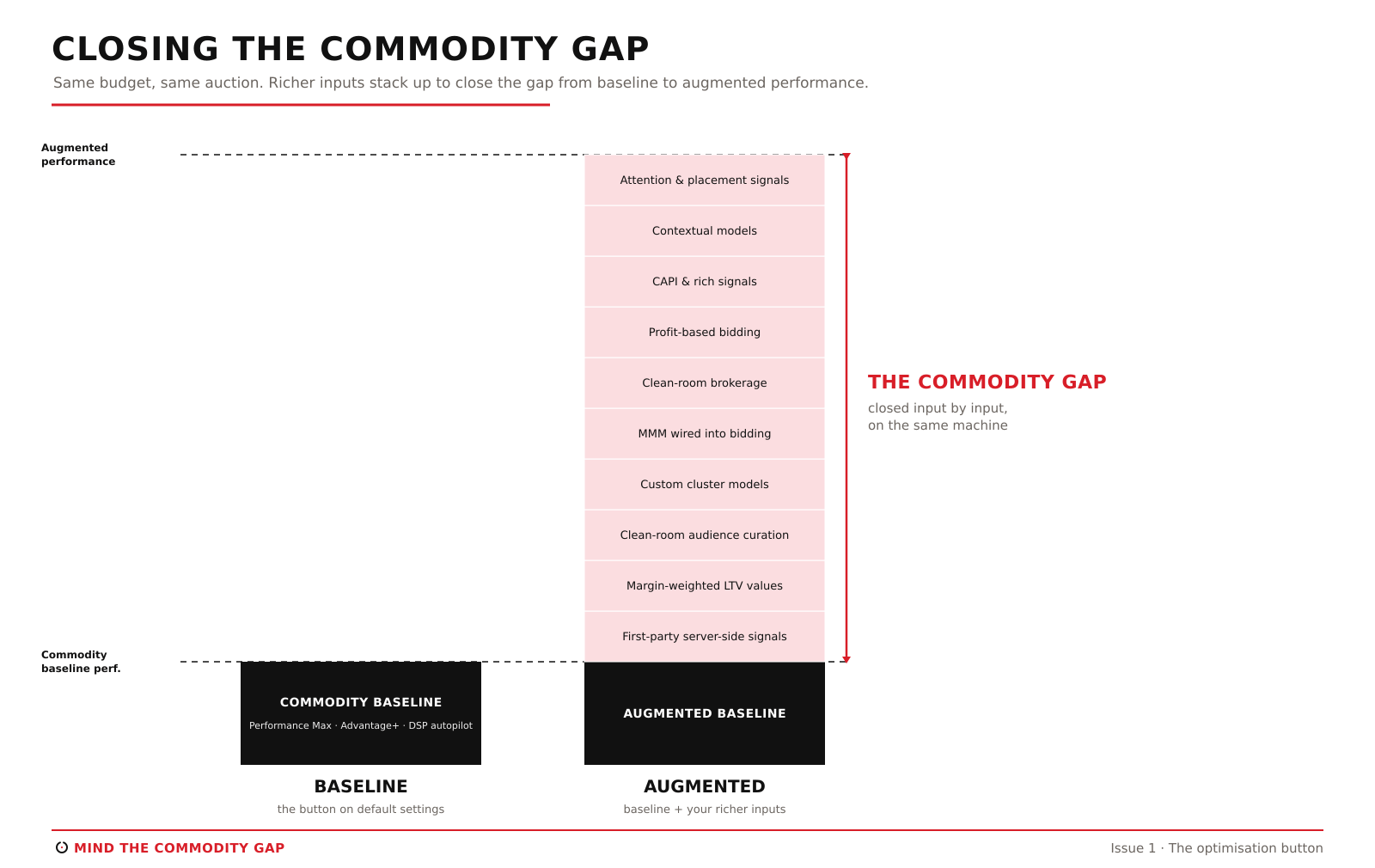
Each layer’s product is another layer’s input and each layer earns more when the layer beside it invests. In an industry built on adversarial economics, that alignment is rare. Put simply. If you’re not adding a layer, you’re someone else’s input and in this market, inputs get commoditised fastest.
Staples wound the original Easy Button down, then brought it back last year for the campaign’s twentieth anniversary knees-up. The reboot carried a different proposition however. The 2005 button promised office supplies on demand. The 2025 one dubbed “E.B.”, sells print, tech support, shipping and the rest of the company’s services. Staples aimed it at higher-margin work. The advertising industry’s button offers no such reinvention, and the brands funding it can ask themselves each quarter which side of it they sit on.
Subscribe to follow the series as it takes each layer apart that is causing the commodity gap. If you run a brand, an agency or an adtech business, this is for you. And forward this to the colleague still wholly pressing the default optimisation button.
This is Erfan Djazmi, fortnightly notes on the commodity gap in marketing, from someone who spent five years at IPG decommoditising agency and client investment.